

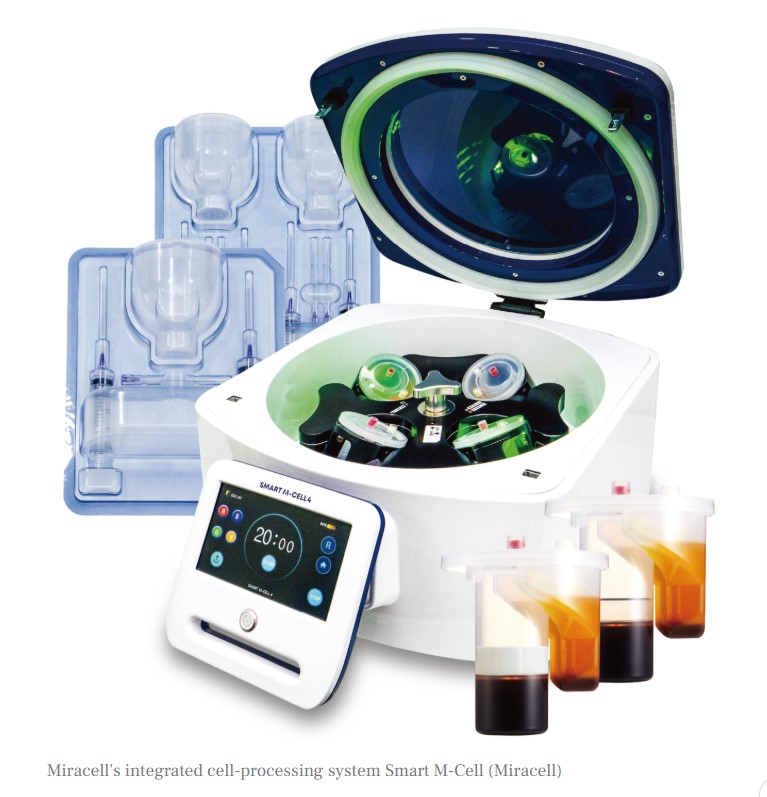
Stem cell technology firm Miracell has secured US Food and Drug Administration 510(k) clearance for its integrated cell-processing system, marking a significant milestone in the company's efforts to expand its presence in the global regenerative medicine market.
The FDA granted 510(k) clearance in April for a system comprising the Smart M-Cell cell concentration device, the BSC blood kit and the BmSC bone marrow kit.
The clearance followed a substantial-equivalence review against SmartPReP, a cell-processing platform developed by the Immune Disease Institute at Harvard Medical School and widely used in regenerative medicine. Miracell said the outcome validates the performance and reliability of its cell extraction and concentration technology.
Stem cells are increasingly being explored in clinical areas including knee osteoarthritis, skin regeneration and antiaging therapies.
In particular, autologous stem cell treatments use cells extracted directly from a patient's own blood or bone marrow, reducing the risk of immune rejection associated with donor-derived cells.
Miracell said it has focused on standardizing the entire cell-processing workflow, from collection and separation to concentration, recovery and administration.
The latest FDA 510(k) clearance covers both the cell-processing device and its designated kits as a single integrated system, providing a framework for obtaining cells of consistent quality.
Unlike conventional centrifuges, the Smart M-Cell is designed to separate and concentrate stem cells and other therapeutic cells from blood and bone marrow while minimizing physical stress that can affect cell viability and function. The company said the system is engineered to preserve the natural characteristics of cells while improving recovery rates and concentration levels.
The Smart M-Cell platform is currently used at more than 700 medical institutions in Korea and has been exported to around 40 countries, including markets in Europe. Miracell said physicians from Spain, Serbia and Greece recently presented clinical cases involving the system at a European medical conference, with related research papers in preparation.
In Korea, researchers at Severance Hospital published findings in the international journal Molecular Neurobiology on the use of autologous blood-derived stem cells processed through Smart M-Cell in patients with severe Alzheimer's disease.
According to the study, patients in the treatment group showed improvements in memory and cognitive function, reductions in amyloid protein levels — a hallmark of Alzheimer's disease — and increased brain metabolism.
Miracell said it plans to expand the application of its stem cell technologies to a broader range of difficult-to-treat diseases as it continues to strengthen its presence in regenerative medicine markets worldwide.